 Founder Compass
How Much of Your Startup Idea Should You Share With a Potential Cofounder? (And Do You Need an NDA?)
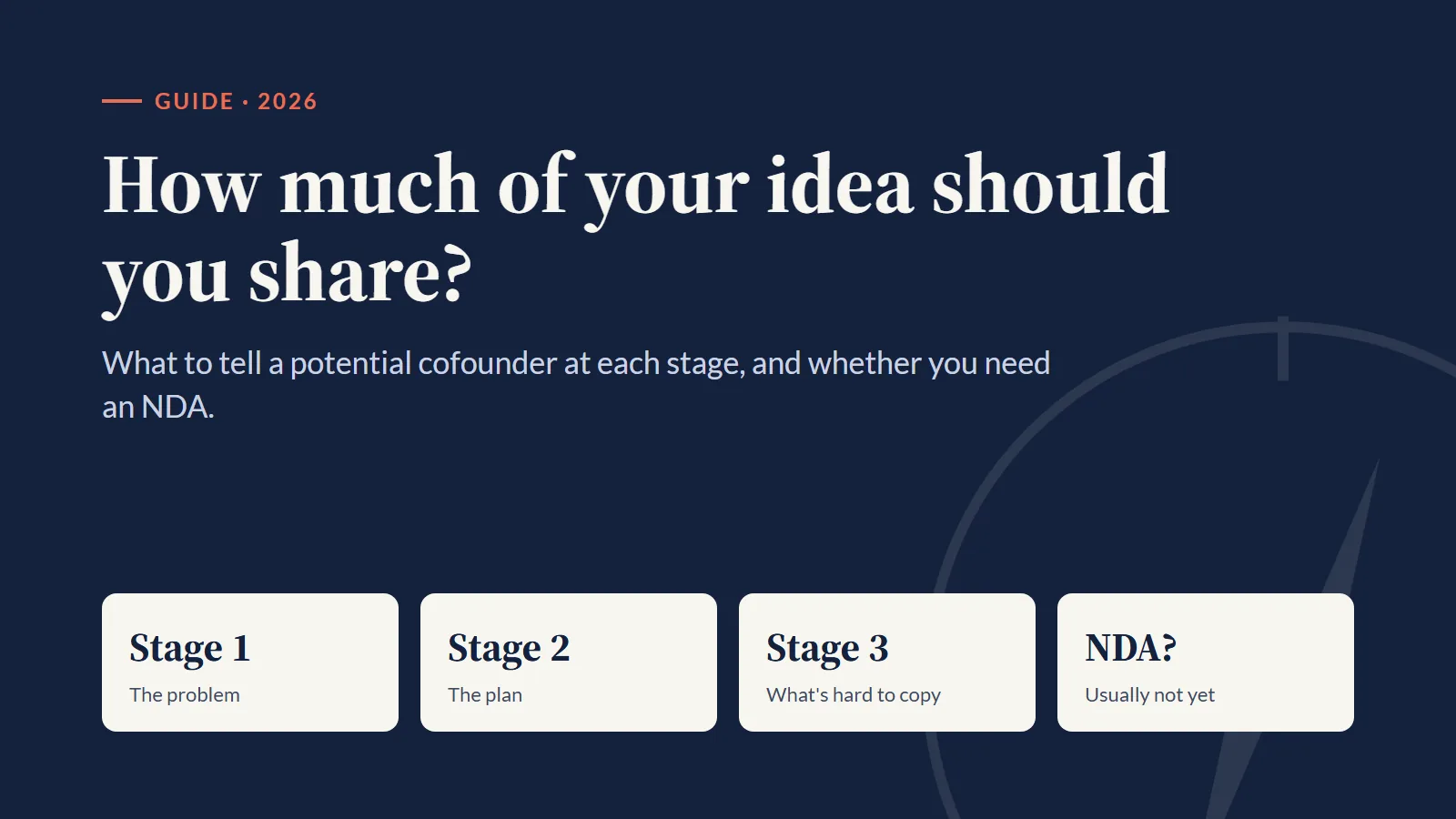
TL;DR: If you'd rather start with people who already fit how you work, try Foundinity, a more focused tool that helps you find the right cofounder: it matches you on how you work, not just skills, and keeps your profile visible only to compatible members. As for your idea: share the problem, who it's for and why you care from the very first call. That's what attracts the right person, and it's very hard to steal. Hold back the few things that are genuinely hard to copy, like a customer list, private data or a unique technical approach, until you've worked together and checked references. Asking a potential cofounder to sign an NDA before a first chat usually does more harm than good. Your real protection is choosing carefully who you talk to.
The worry every founder has
A founder in India who talked to more than 15 others about finding a cofounder found the same tension again and again: sharing the idea feels risky, but not sharing gets you nowhere. People worked around it with screening calls, sharing in stages or keeping things to DMs, but nobody had a real structure (r/indianstartups).
A team looking for a technical cofounder on YC's platform asked the same thing: how much of the idea should they share up front, given that NDAs seemed unrealistic (r/ycombinator).
Here's a structure.
Why the idea is rarely what's at risk
In 2005, Derek Sivers described ideas as "just a multiplier of execution". In his rough scoring, a brilliant idea is worth 20 and an awful one -1. Execution ranges from $1 for none to $10,000,000 for brilliant. Multiply the two and you see why a great idea with no execution is worth almost nothing. "Ideas are worth nothing unless executed," he wrote (Derek Sivers).
For a cofounder search, that means two things:
- The person you're talking to can't easily take your idea and win with it. If they could execute it alone, they probably wouldn't be looking for a cofounder.
- The bigger risk is the opposite one. Saying too little means the right person never gets excited, and you spend months talking to people who were never a fit.
Share in three stages
Stage 1: the first call (share freely)
- The problem, and who has it.
- Why you care, and what you've seen that others haven't.
- What you've done so far: interviews, a prototype, early users.
- The kind of company you want to build, and the role you need filled.
This is the part that attracts a good cofounder. It's also the part that's least valuable to anyone else.
Stage 2: after a good second conversation (share the plan)
- Your approach and how it's different.
- Early numbers: sign-ups, interview results, revenue.
- Your rough roadmap and what you'd build first.
By this point you should have answered some hard questions together, like why you each want to start a company, how much time you can give and how you'd work. YC suggests each of you answers these separately and then compares (YC).
Stage 3: during a trial project (share what's hard to copy)
- Customer names and contacts.
- Private data, partnerships you're negotiating, or anything you've been told in confidence.
- A genuinely unique technical approach, if you have one.
Only share these once you've worked together on something real and checked a couple of references.
What's actually sensitive (and what isn't)
Not worth hiding:
- The basic idea. On its own, it's rarely what makes a company work.
- The problem you're solving.
- Your vision for the company.
Worth protecting until you trust someone:
- Customer lists and contacts.
- Data that took you a long time to collect.
- Deals and partnerships in progress.
- Code or technical work you've already built.
Do you need an NDA with a potential cofounder?
Usually not for the first conversations. This isn't legal advice; for anything specific, talk to a lawyer.
The case against an early NDA has been made for years. An OnStartups essay from 2006 argues that sharing early helps you find competitors, partners and customers, that an NDA is "likely not going to give you the protection you think it is", and that experienced people generally won't sign one at an early stage anyway (OnStartups). Its advice: don't rely on an NDA to protect the truly secret parts. Keep those private instead.
With a cofounder there's a second cost. You're trying to start the most trust-heavy relationship in your company. Opening with a legal document tells the other person you don't trust them yet, which they may read as a sign of how you'll work together.
If you get to Stage 3 and there's something genuinely confidential to share, that's the point to get proper advice, not the first coffee.
Check them before you share more
Your best protection is choosing who gets to Stage 3.
- Ask for specifics. What did they personally build or deliver in past roles? People who really did the work remember the details.
- Check references, openly. YC suggests talking to people who've worked with a potential cofounder (YC).
- Do a short trial project. You'll learn more about someone in two weeks of working together than in ten calls. Our guide to the best places to find a cofounder covers where to meet people worth that time.
Keeping your search private
Many founders don't want their employer, or the whole internet, to know they're looking. That's partly why Foundinity works the way it does:
- You can set your status to "exploring", and your profile is visible only to compatible members.
- You state your preferences, then a deeper assessment captures how you work: working style, ambition, commitment, vision and values. Its algorithm, "built on established psychological compatibility models", ranks the result, so the people you share with are already a closer fit.
- Every match shows where you align and where you differ, and gets a 10-day clock so it turns into a real conversation.
It's free to get started. It doesn't replace the checks above; it means you run them on people more likely to pass.
FAQ
Will a potential cofounder steal my startup idea?
It can happen, but it isn't the main risk, and the idea alone is rarely what makes a company work. The bigger risk is wasting months with the wrong person. Share the problem and your vision freely, and hold back only the things that are genuinely hard to copy.
Should I ask a potential cofounder to sign an NDA?
Not before the first conversations. It offers little protection at that stage and can start the relationship on the wrong foot. If you later need to share something genuinely confidential, get proper legal advice then.
What should I never share on a first call?
Customer contacts, private data, deals in progress and code you've already built. Everything else, especially the problem and why you care, is worth sharing.
How do I pitch my idea to a potential cofounder without giving it away?
Lead with the problem, the people who have it and what you've learned so far. That's what convinces a good cofounder, and it gives nothing useful to someone who isn't.
Is it safe to look for a cofounder on a matching platform?
Choose one that keeps your profile private. On Foundinity, your profile is visible only to compatible members. On big directories, read the platform's privacy settings, and see our review of YC Cofounder Matching for how its visibility works.
Sources: r/indianstartups: "Talked to 15+ founders about finding a co-founder in India" · r/ycombinator: "Advice on best platforms to find technical co-founders" · Derek Sivers: Ideas are just a multiplier of execution (2005) · OnStartups: The Fallacy of the Non-Disclosure Agreement (2006) · YC: 10 Questions to Discuss with a Potential Co-founder